

How might we detect or measure the acceleration of the world? When pundits, alarmists, and dystopians declare that the world is moving too fast for us to keep track, how is it that they are estimating rates of cultural change and how do they establish that these changes are too fast for individuals and society to respond? We all know the answer: plotting a few exponentials, sprinkling around the word “singularity,” and neglecting the science of adaptation.
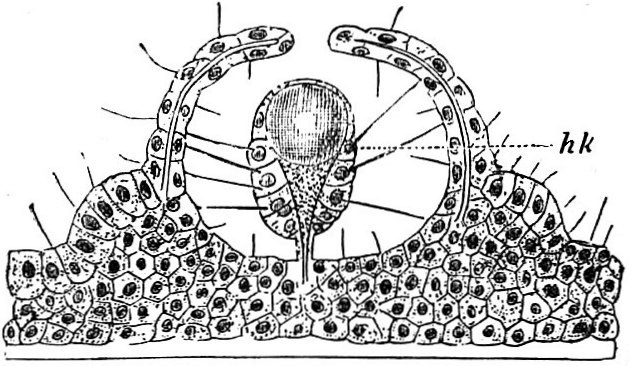
It is a curious fact of evolution that every organism that measures acceleration — that possesses a working accelerometer — does so in more or less the same way. Each organism contains an organ in which a “proof mass” is suspended on a mechanosensory hair in a fluid-filled chamber. The proof mass is inertial, and upon movement, it lags behind the basement membrane to which the hair is attached. The strain in the hair generates receptor potentials by opening ion channels, which are processed into an estimate of acceleration.
All evolved accelerometers face a series of unavoidable physical trade-offs. The minimum acceleration is bounded by a thermal noise floor: the smaller the proof mass, the harder it is to distinguish real motion from thermal fluctuations. This leads to a design choice through a bandwidth-sensitivity trade-off: For a small mass to counter noise, it needs to be suspended on a very stiff hair, and this limits the ability to detect low-frequency variation. This is why the semicircular canals in the human ear, using relatively massive otoliths, can detect low-frequency rotational acceleration on the order of 0.1Hz, whereas tiny insect campaniform cells can only detect changes two orders of magnitude higher. And all evolved accelerometers need to deal with viscous regimes — where the proof mass is strongly coupled to the surrounding fluid medium and fails to provide any evidence of relative motion.
We can extend these insights in a fairly straightforward way to knowledge and culture. Let’s treat the quantity of accumulated and connected cultural knowledge — all of those ideas that are coordinated into a correlated system of verified belief — as analogous to proof mass. Any paradigm change in a field induces a rate of change in the epistemic environment, and this is the acceleration we would like any “cultural accelerometer” to detect.
Just as with evolved accelerometers, there is a need to distinguish noise (misinformation, rumor, error) from signal. We know from Bayes’ rule that the prior plays the role of the proof mass: the greater the accumulated evidence for the incumbent beliefs, the greater the inertia in the system. And, we know the rate of updating maps to the stiffness of the mechanoreceptor: a commitment to the status quo reduces sensitivity to genuine signals for change but increases resistance to noise. Additionally, viscous regimes are those in which the zeitgeist is absolutely dominant — social pressures of various kinds induce a lock-step between individual and collective knowledge flow.
Just as insects detect high-frequency impulses at low sensitivity, and mammals detect low-frequency impulses with high sensitivity — a binding trade-off no life form can overcome — human society, with its high proof mass, has evolved to detect low-frequency changes with high sensitivity. Technologies offer the possibility for an invertebrate complement, responsive to high-frequency changes. And yet we have been building AI systems with fixed weights that are, in effect, an extreme version of the mammalian otoconial layer — mineralized once and rarely replaced. The proof mass doesn’t just resist change — it cannot change until retraining.
Now might be the right time to learn from the adaptive capabilities of crustaceans. The crustacean proof mass — statolith — is discarded at every molt and replaced. Each individual picks up sand grains and places them in the statocyst to rebuild its proof mass. If you give a shrimp iron filings instead of sand, it builds a ferromagnetic statolith and then orients to a magnet instead of gravity. The proof mass is expendable, replaceable, and reconstructed from environmental materials. The crustacean doesn’t carry its reference frame across molts — it rebuilds it from whatever the current environment provides. Now that’s a model for sustainable technology.
— David Krakauer
President, Santa Fe Institute
From the Spring 2026 edition of the SFI Parallax newsletter. Subscribe for our monthly e-Parallax, or email “news at santafe.edu” to request quarterly home delivery in print.
Thanks, adaptation is never free, and stability is not just protective. Past a certain point, it can become its own kind of blindness.
I love the crustacean model, but it's reactive: it rebuilds proof mass from whatever the current environment provides. What if you're always calibrating to a world on its way out?